docspack
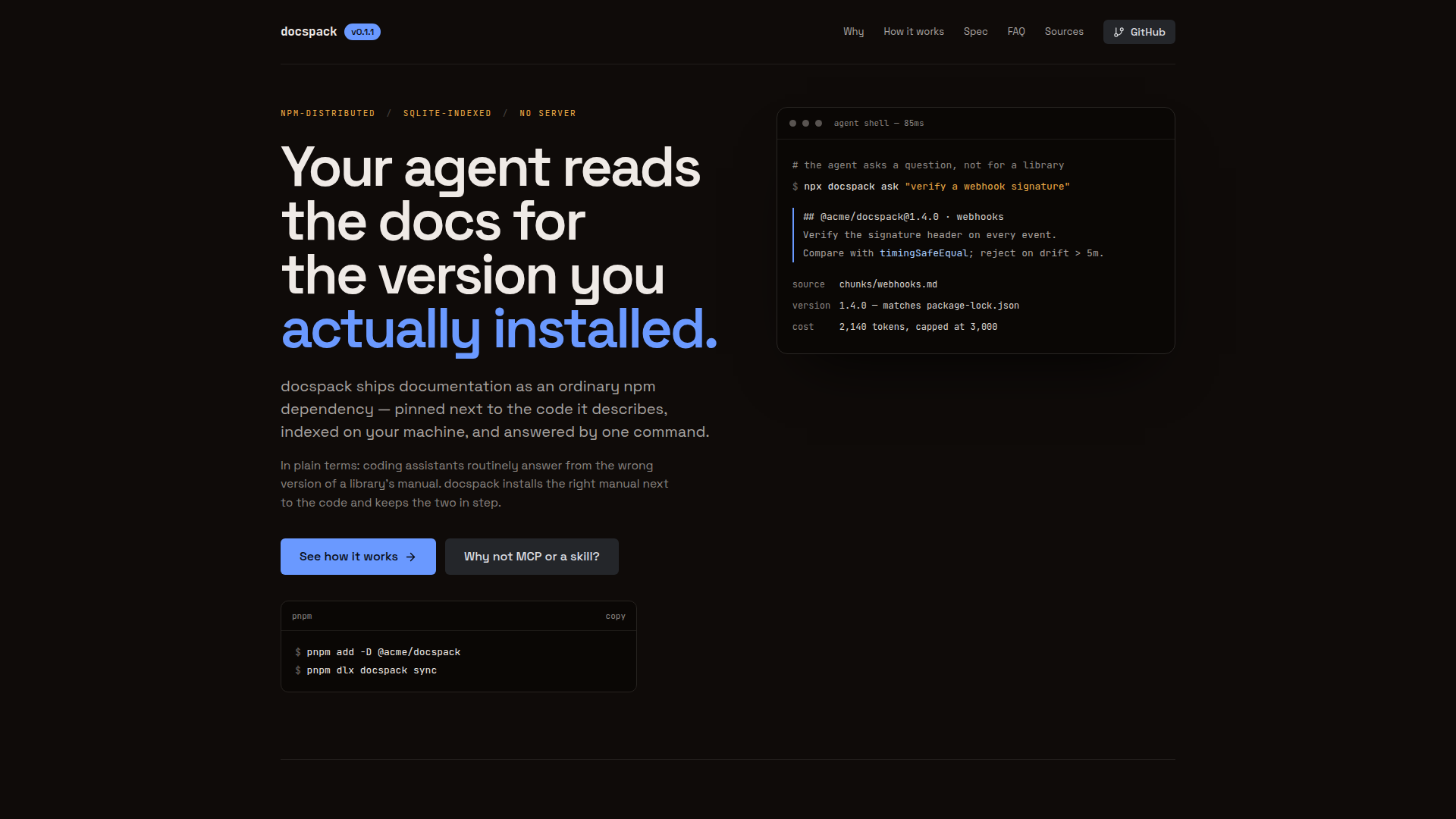
Coding agents answer questions about a library from three unreliable places: training data that has drifted, a web fetch of whatever the docs site shows today, or a guess. None of them know which version you actually installed. docspack closes that gap by shipping documentation the same way code ships — as an npm package, pinned in your lockfile next to the library it describes.
A docs pack is just files: Markdown chunks split at headings plus a manifest, published as an ordinary package like @acme/docspack. docspack sync indexes every installed pack into a local SQLite database with FTS5 full-text search, and docspack ask "verify a webhook signature" returns the matching chunks — offline, no server, and capped at roughly 3,000 tokens per query so a lookup costs about one percent of a typical context window instead of the whole documentation site. It runs as a CLI and as an MCP server.
Authors don't have to write anything new to start: a pack can be generated from an existing ./docs folder, an OpenAPI file, or a public llms.txt. And when an agent notices the docs are wrong — an export that no longer exists, a signature that changed — it can record the drift locally with docspack feedback add and submit it deliberately, rather than broadcasting noise at maintainers.